
No. 01
"It came from WhatsApp"
Re-encoded, stripped of EXIF, no timestamp authority, no binding to the device that captured it. A defence lawyer rejects it in thirty seconds.
Forensic scene documentation · iOS and Android
A single mobile app turns every photo, video and audio recording taken on-site into a signed, RFC 3161 timestamped, BagIt-packaged piece of evidence — ready from the moment of capture.
Not a date stamped on the photo: a date that isn't yours, a fingerprint you can't alter, and a package anyone can verify — including against you.
Get the app
What does Locus do?
It creates multimedia evidence that verifies itself — intact, signed, timestamped and interoperable — with no lock-in to the software vendor.
What is LOCUS
LOCUS captures photos, videos and audio and wraps them in a self-contained « bundle » — intact, reliably timestamped and verifiable by anyone, with no need to trust the vendor.
Every acquisition produces a package that holds the evidence together with all the metadata, cryptographic signatures and timestamps needed to prove its integrity, authenticity and spatio-temporal placement.
The format is not proprietary: it rests entirely on open standards recognised internationally, so the evidence can be validated with free tools already present on common operating systems.
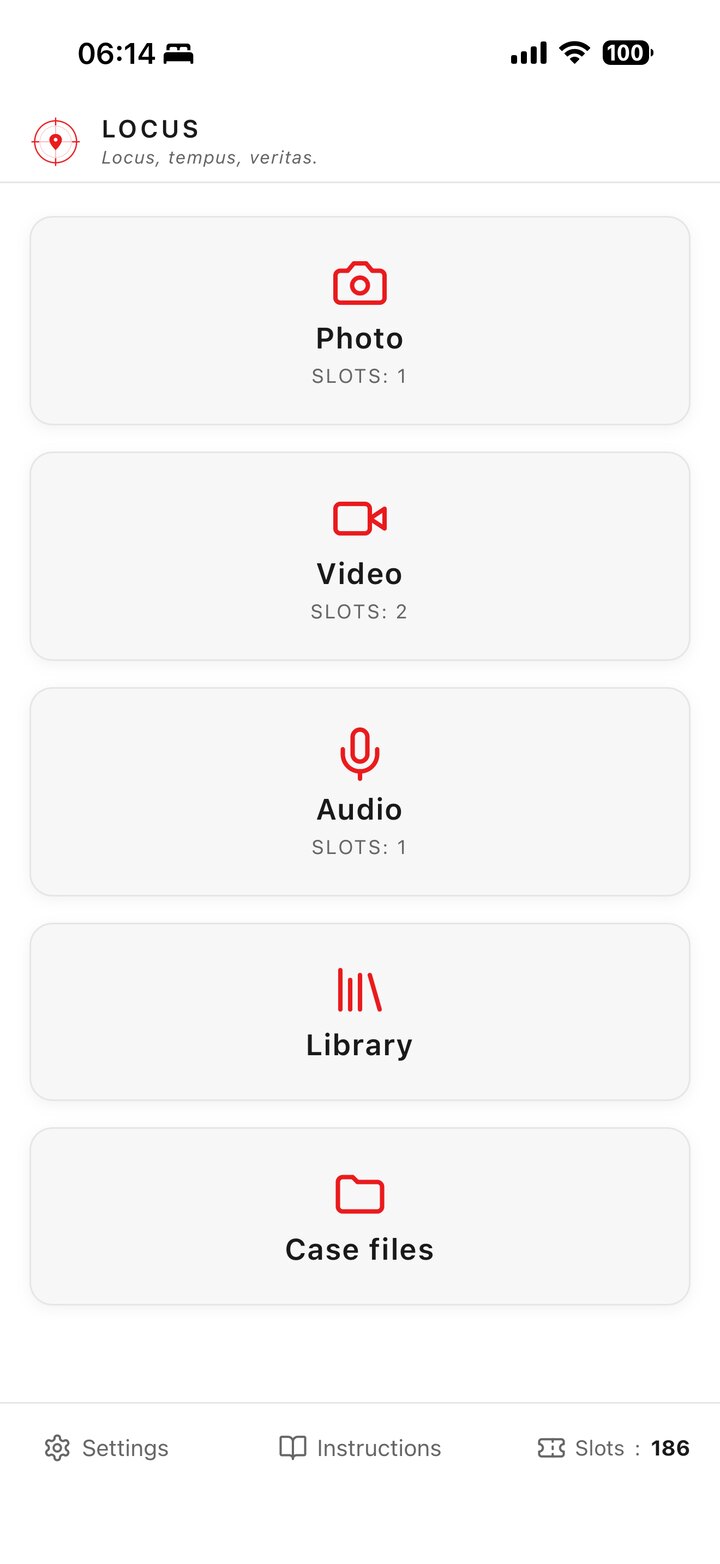
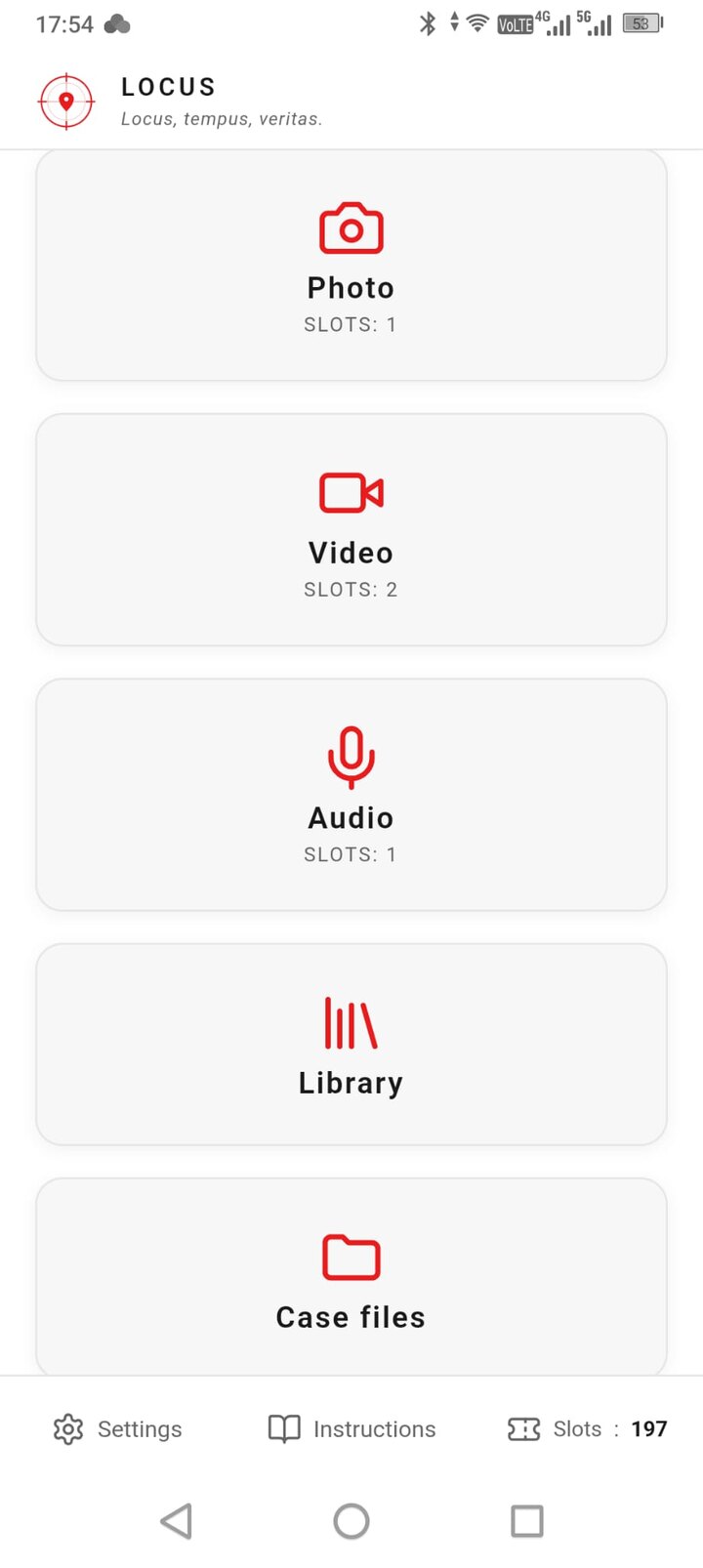
Privacy first
Photos, videos and audio never leave the device except inside the sealed bundle, which stays with you. Only the mathematical proof of the media reaches the LOCUS server — cryptographic hashes, perceptual hashes and any histograms of the generated images — plus the operation metadata. The server checks integrity by fingerprint only: it neither receives nor stores the image, video or audio. Whether it’s a photo, a video or audio, the LOCUS server will never know what it is.
The content travels only with the bundle, according to your documentation needs. On the server, never the scene: only its digital fingerprint.
§ 02 · The gap
Three reasons why ordinary captures fall apart the day they are challenged in court.
No. 01
Re-encoded, stripped of EXIF, no timestamp authority, no binding to the device that captured it. A defence lawyer rejects it in thirty seconds.
No. 02
Where was it taken? Who was there? Which camera? What time — and according to whose clock? Without context, a photo is just pixels.
No. 03
You cannot redo a scene survey. Either it is acquired correctly the first time, or the evidence is gone forever.
The Zero-Trust principle
« Never trust, always verify. » LOCUS brings the Zero-Trust principle to digital evidence: every bundle verifies itself, with free, open tools already present on common operating systems — with no need to take our word, an expert’s or an authority’s. Maths replaces trust.
A hash allows no rebuttal: it matches, or it doesn’t.
§ 03 · How it works
Every step runs automatically on-device. The user shoots; the app seals. No technical knowledge required of the operator.
Authoritative time fix from time.cloudflare.com
Native camera, raw frame, no filters applied
3-line burn-in: time · UUID · GPS+heading
Camera metadata preserved + LOCUS UserComment
MD5 · SHA-256 · SHA-512 in one pass
Sectigo→DigiCert→GlobalSign + InfoCert eIDAS opt-in
Device-bound keypair, manifest signed
JSON-LD sidecar: Image · Device · Location · Provenance
Forensic report ready for the case file
RFC 8493 packaging + tagmanifest TSA
Only metadata + fingerprints on the server (never the media), certified e-mail notification
The guarantees
Nine guarantees, each obtained through a cryptographic or data-minimisation mechanism that can be verified independently.
No. 01
Two layers of SHA-256 hashes over payload and control files, in BagIt format: changing a single byte makes verification fail.
No. 02
Ed25519 digital signature of the manifest, generated from the device private key.
No. 03
Two RFC 3161 timestamps issued by an accredited Time Stamping Authority (Sectigo).
No. 04
A LOCUS-PROV-v1 manifest embedded in the media itself, for photo and video.
No. 05
The capture pipeline is declared in the signed manifest (computational vs raw; no generative AI editing).
No. 06
Chain of custody in CASE/UCO format, interoperable with the main forensic tools.
No. 07
Offline verification scripts and a documented manual procedure, with no dependency on the vendor.
No. 08
The actual content (photo/video/audio) is never transmitted or stored on the server: it stays in the bundle. Only the histogram and signed perceptual hashes are uploaded; public verification reveals neither the image nor the GPS.
No. 09
For Italian users with a valid PEC: a certified receipt with independent trusted time, held by a third party.
Inside the app


Multi-modal capture


Italian market
Once the seal is complete, LOCUS automatically sends an acquisition notification. If you have set an Italian Certified E-mail (PEC) in your profile, it is delivered via PEC with a delivery receipt that has legal value (DPR 68/2005, art. 48 of the Italian Digital Administration Code). If you only set a regular e-mail, you receive a plain informational e-mail, with no certified receipt. In both cases the message carries the acquisition report — triple hashes (MD5/SHA-256/SHA-512), RFC 3161 timestamp, manifest signature, device, GPS and NTP data — plus the verification code for independent cross-check. The actual media (photo/video/audio) is NOT carried in the notification and is NOT on the server: it stays in the bundle you keep; online there is only the public verification page with histogram and fingerprints.
§ 04 · Compliance
Conformity references — not certification logos — that govern the bundle structure.
| Reference | Scope | Where in LOCUS |
|---|---|---|
| ISO/IEC 27037:2012 | Identification, collection, acquisition and preservation of digital evidence | Full pipeline |
| SWGDE 18-F-002 · 17-V-002 · 23-I-001 | Digital-evidence acquisition · forensic video/audio · imaging best practices | Capture flow, chain of custody |
| RFC 3161 | Time-Stamp Protocol with authoritative trusted authority | Media + tagmanifest |
| Provenance LOCUS-PROV-v1 | Content provenance, inspired by C2PA/JUMBF (NOT standard C2PA) | APP11 (JPEG) · BMFF uuid box (MP4) |
| CASE 1.3 / UCO 1.4 | Cyber-investigation Analysis Standard Expression | JSON-LD sidecar |
| BagIt RFC 8493 v1.0 | Hierarchical filesystem packaging for transfer | Bundle root |
| EXIF 2.32 | Exchangeable image file format | Preserved unaltered in JPEG |
| eIDAS 910/2014 | Qualified electronic time-stamps (legal value in EU) | Optional via InfoCert TSA |
§ 05 · Who uses it
LOCUS is designed for those who answer to a judge, an insurer, or a board — not for social-media collectors.
Photographic survey of the contested scene with hash + signature ready to cite in the report.
On-scene survey by judicial police. Bundle attachable to the report.
Fire-origin and accident scene documentation.
Construction sites, ATP and structural surveys with unchallengeable photo evidence.
Damage assessment that cannot be contested for tampering or backdating.
Lawful documentation packaged for the defence lawyer.
Incident response with verifiable evidence for internal investigations.
Evidence collection from the office, immediate delivery to the file.
Dated, geo-referenced crop-damage assessment for compensation.
Dated conservation state of artworks and cultural assets.
Condition of goods at loading/unloading and in-transit damage.
State of common areas, damage and leaks in disputes.
§ 06 · Pricing
A prepaid slot system, designed for legal admissibility. No subscription, no expiration. The more you buy, the lower the unit cost.
How slots are consumed
Slots are purchased and topped up here on the website, from your account: the mobile app only uses them to acquire. Go to your account →
Starter
5 slots
€ 30
€ 6.00 per slot
Business
50 slots
€ 240
€ 4.80 per slot
Enterprise
500 slots
€ 1,800
€ 3.60 per slot
§ 07 · Public verification
Type in the 6-character short code printed in the report or the email and we recompute every cryptographic check live.
Public verification — no login required.
§ 08 · Trust by transparency
Locus Validator is the standalone, open-source desktop counterpart of the mobile app — built with the same stack. It recomputes every cryptographic check locally and runs fully offline, with no account required. When a bundle fails and you are online, it can additionally cross-check it against the authoritative server record to pinpoint exactly what was altered — file, hash, signature or timestamp; the only thing it ever sends is anonymous telemetry of validation outcomes — never your identity or the evidence. And if you would rather install nothing: every bundle is self-verifying — it ships with verify.sh/verify.bat and an interactive.html report with in-browser hash validation.


§ 09 · Questions
Honest answers, no marketing fluff.
To turn what you see into evidence. You take a photo, record a video or capture audio from your phone and LOCUS produces a signed bundle with location, a certified date and a cryptographic fingerprint: the content stays tied to the place and moment it was captured, and anyone can verify it.
On its own, little: an image is easy to edit, EXIF metadata can be rewritten and the phone's date can be changed. You need something the photographer does not control — a third-party timestamp and a cryptographic signature — and that is exactly what LOCUS adds to the shot.
Not with EXIF metadata, which anyone can rewrite. LOCUS records the location at capture time and seals it together with the content in a signed bundle, dated by an RFC 3161 timestamp issued by a third-party authority: the date does not depend on the phone's clock.
LOCUS captures the physical world from your phone (photos, video, audio with location): it is for use on site, during an inspection. C.E.R.T.O. is the desktop app and acquires content that lives online (web pages, email, chats, cloud). Slots are shared between the two on the same account.
No. Without a connection the RFC 3161 timestamp — the third-party trusted date that gives the acquisition its evidentiary value — cannot be applied, so LOCUS requires an Internet connection to acquire. The Photo, Video and Audio buttons stay disabled until the network is available.
Android 7.0+ (any vendor, including ruggedised) and iOS 17+. The same bundle format is produced on both platforms.
Slots are purchased and topped up from your account here on the website (the Slots section of your dashboard); the mobile app only uses them for acquisitions and does not sell slots inside the app. Sign in to your account →
The standard timestamp uses public RFC 3161 TSAs in a cascade (Sectigo → DigiCert → GlobalSign), non-qualified. InfoCert is an eIDAS Reg. 910/2014 qualified authority — the timestamp has full legal value in the EU. Both are RFC 3161; legal weight differs.
LOCUS produces robust evidence that any third party can verify independently: a documented chain of custody, cryptographic integrity (hash triple + Ed25519 signature), a trusted date via RFC 3161 timestamp and — on opt-in — an eIDAS-qualified timestamp with full legal value in the EU. Admissibility and evidentiary weight are for the judge to assess case by case: no tool can guarantee them in advance. LOCUS is built to withstand cross-examination — the opposing party, court experts and prosecutors can recompute the checks themselves, even offline, without relying on us.
Absolutely. The bundle is a plain ZIP following the BagIt RFC 8493 v1.0 specification. Any operating system, any text editor, openssl, and a PDF reader are enough to inspect everything.
Two ways: the public web page /verify/<code> on this site, or the standalone offline app Locus Validator (macOS + Windows + Linux).
Every bundle is signed with an Ed25519 key bound to the device (registered TOFU on first use), and the manifest records the operator identity and the device fingerprint. The signature inseparably binds content, device and moment of sealing: a bundle from a different device or operator would carry a different key, detectable on verification.
No — and that is the whole point. Any change, even a single byte, breaks the hash triple, the Ed25519 signature and the timestamp: verification (public page or Locus Validator) detects it immediately and flags the bundle as altered. The evidence is tamper-evident by design.
The actual evidence content (photos, videos, audio) lives only in the BagIt bundle on the user's device, who keeps it and shares it according to their own documentation needs: the user is the custodian of the evidence. On our servers — hosted in the European Union with a GDPR-compliant provider — we keep only account and billing data and the acquisition metadata (cryptographic and perceptual fingerprints, histogram, technical parameters and GPS coordinates): never the actual media. The public verification page discloses neither the image nor the GPS location. Data minimisation is structural (privacy by design) and standard GDPR rights apply (EU Reg. 2016/679): access, rectification, erasure, portability and objection.
No. For confidentiality the actual evidence content (photos, frames, video, audio) is never transmitted or stored on our servers: it stays only in the sealed BagIt bundle you hold. We upload only a histogram image and the perceptual hashes (signed in the manifest): they represent the media without revealing its content. The public verification page shows the histogram — never the real image — and does not disclose the GPS position. The Locus Validator recomputes the histogram and perceptual hashes from the media in the bundle and confirms they match, fully offline.
You are the custodian of the evidence: the actual content lives only in the BagIt bundle you hold, so always keep a backup copy (cloud, NAS or external drive). Our servers keep the verification record and the acquisition metadata — useful to confirm the authenticity of an existing bundle — but not the media: if you lose the bundle we cannot reconstruct it.
The PDF report and the BagIt bundle can be attached as-is. The hash triple and the TSA token are quotable in the report; the signed manifest is the formal proof.
One slot per forensic photo or audio, two per video. The eIDAS-qualified timestamp adds +2 slots. Slot packs start at €30 (5 slots, €6.00 each) and the per-slot price drops with volume, down to €3.00. Dedicated discounts for law-enforcement and public bodies.
No subscription. Slots are bought as you go and never expire: use them whenever you need. They are not refundable in cash. The same wallet is shared with the C.E.R.T.O. desktop suite by AcquisizioniForensi.it.
Create an account, copy your API key from the dashboard and enter it in the app, then point the camera. The forensic pipeline runs on its own. No training required, no installation on a forensic workstation.
§ Guides
What makes a photo defensible, why a phone clock proves nothing, how the opposing party can verify your evidence. Practical guides, no jargon.
Read the guides§ The other product
Web pages, chats, email and cloud are captured from the desktop with C.E.R.T.O. — same chain of custody, same slot pool: the slots you buy work for both.
Discover C.E.R.T.O.Two free slots when you sign up. No credit card required. First bundle ready in two minutes.
Get the app