Regulation
Deepfakes and Italian corporate liability: why documenting media origin protects your business
The unlawful distribution of content manipulated using artificial intelligence can also expose a company to liability. Documenting the origin of audiovisual material, preserving its integrity and keeping track of subsequent processing provides a practical safeguard. LOCUS helps businesses build this evidence from the moment of acquisition.
A voice may sound like a chief executive’s. A video may attribute words to an employee who never said them. A photograph may show someone in a situation that never happened. For businesses, the concern extends both to fabricated content used against them and to the content they produce, commission and distribute.
When a dispute arises, saying “our material is authentic” carries little weight without verifiable documentation. The business needs to reconstruct how the file was acquired, what information accompanies it, how it was processed and which version was authorised for distribution.
What has changed under Italy’s corporate liability framework
With effect from 30 September 2026, Legislative Decree 160/2026 added Article 25-vicies to Legislative Decree 231/2001, Italy’s framework governing corporate liability for offences committed by individuals. The provision covers two offences: failure to adopt safety measures and unlawful alteration of high-risk AI systems under Article 437-bis of the Italian Criminal Code, and unlawful distribution of AI-generated or AI-altered content under Article 612-quater. For the latter, the corporate financial penalty ranges from 200 to 700 penalty units; for the former, from 600 to 1,000. Source: Legislative Decree 160/2026, Article 15 (Normattiva, in Italian).
| Provision | Predicate offence | Corporate penalty |
|---|---|---|
| Art. 437-bis Criminal Code | Failure to adopt safety measures and unlawful alteration of high-risk AI systems | 600 to 1,000 penalty units |
| Art. 612-quater Criminal Code | Unlawful distribution of AI-generated or AI-altered content | 200 to 700 penalty units |
| Arts. 9 and 13, Decree 231/2001 | Both offences (Art. 9(2)(b)-(e)) | disqualifying sanctions, subject to the statutory conditions |
Article 612-quater, previously introduced by Law 132/2025, requires the transfer, publication or other distribution, without consent, of AI-falsified or AI-altered images, videos or voices capable of misleading people about their authenticity, and resulting in wrongful harm to a person. The individual offender faces one to five years’ imprisonment. Prosecution generally requires a complaint by the injured party, subject to the statutory exceptions. Simply producing synthetic content does not automatically constitute this offence. Source: Law 132/2025, Article 26.
Corporate liability also requires the conditions set out in Article 5: an offence committed in the company’s interest or for its benefit by a person in a senior position or someone under their direction or supervision. The involvement of an external agency does not, by itself, make the client company liable. Source: Legislative Decree 231/2001, Article 5.
Disqualifying sanctions are also provided for, subject to the statutory conditions. These include suspension or revocation of authorisations, licences or concessions used in committing the offence; a ban on contracting with public authorities; exclusion from financial benefits; and a ban on advertising goods or services. Sources: Articles 9 and 13 of Legislative Decree 231/2001.
Where the business risk arises
The processes to examine are those in which images and recordings move between individuals, departments and suppliers:
- Marketing and communications: simulated testimonials attributed to real customers, faces inserted into campaigns and voices recreated without authorisation.
- Sales: approvals or statements attributed to people who never gave them.
- Human resources: manipulated recordings used in employment disputes.
- External suppliers: material entrusted to agencies and partners without instructions on permitted processing and checks before distribution.
These scenarios need to be assessed against all the elements of the offence; they are not a list of actions that are invariably criminal. Nevertheless, checks should take place before distribution. Removing content may limit its consequences, but it does not undo harm already caused.
Documenting origin as a business safeguard
The first practical step is to preserve verifiable source material. Who acquired it? With which device and capture method? What time and location information is available? Does the file presented today match the one originally preserved?
This safeguard helps the business in two ways. Internally, it distinguishes acquired material from processed versions and links each publication to the relevant permissions. Externally, it provides a documented reference when manipulated content circulates or the integrity of a file is challenged.
The transparency obligations under Article 50 of the AI Act, including disclosure of the artificial nature of deepfakes where required, remain a separate matter. A label does not replace consent or reconstruct the history of the original material. Source: European Commission, Article 50.
What your business receives when it acquires material with LOCUS
LOCUS is AcquisizioniForensi.it’s tool for acquiring photos, video and audio and preserving them in a verifiable evidence package. Documentation is created during the acquisition workflow and linked to the material through cryptographic hashes, a signed manifest and timestamps.
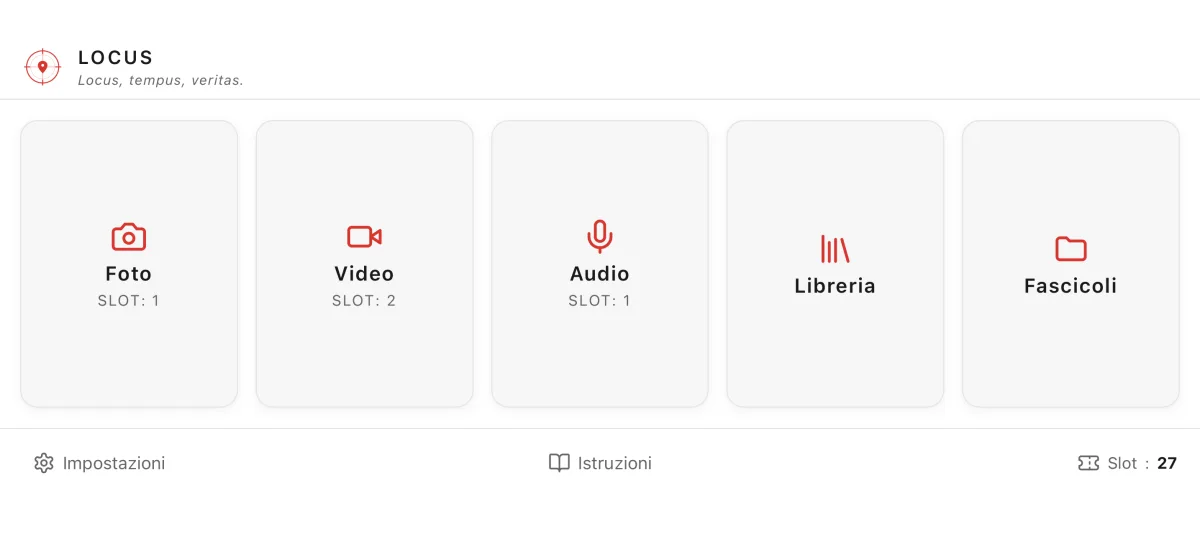
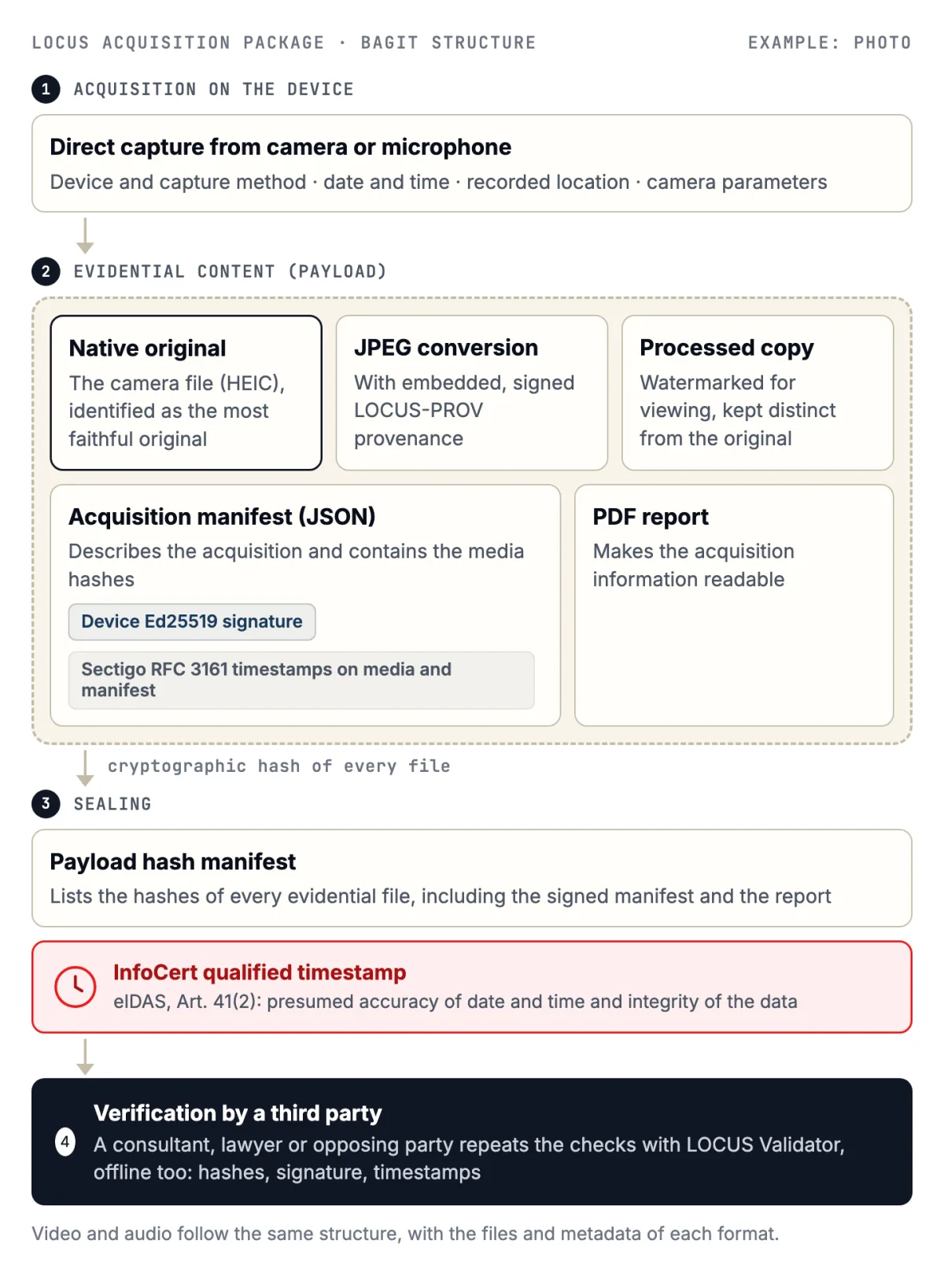
At the end of the acquisition, the business receives a package it can preserve and, when necessary, provide to its lawyer, a consultant or anyone who needs to verify the material. Alongside the photograph, video or audio recording, the package contains acquisition information, a report and the elements needed to check the files. Its BagIt structure organises these elements and allows their completeness and integrity to be checked.
The value for the business lies in what each element allows it to demonstrate.
The source material remains available
To compare published content with acquired material, you need to be able to retrieve that material. In the photographic package examined for this article, LOCUS preserves the camera’s native HEIC original, a JPEG conversion and a processed copy with a watermark. The manifest explicitly identifies the most faithful original and distinguishes the processed copy.
For the customer, this means being able to provide both the source material and the version prepared for viewing, with a clear distinction between them. Photos, video and audio follow the same principle of documented acquisition and protection through hashes, manifests and timestamps, with files and metadata appropriate to each format.
The origin is supported by verifiable information
The package documents the capture method, device, time references and recorded location, according to the information available. In the photographic sample, the manifest records direct capture through the iPhone camera and identifies the API used. It also preserves camera parameters and GPS data.
This information is collected in the manifest: the document describing the acquisition and media hashes, automatically signed using the device’s Ed25519 key. Verifying the signature makes it possible to check that the signed information has remained intact. For the business, the result is material accompanied by documentation of its acquisition process, which can be used to reconstruct its provenance. The device signature is not equivalent to a person’s qualified electronic signature.
You can check whether a file has changed
LOCUS calculates cryptographic hashes of the files: values that allow material presented later to be compared with the material identified in the package. If a file is modified, comparing it against the preserved hash makes the difference detectable. The checks also cover the documentation listed in the hash manifest.
In the bundle examined, the hashes of all 12 evidence payload files matched, including the native HEIC original. The manifest’s Ed25519 signature and the signature on the LOCUS-PROV provenance information embedded in the JPEG copy also verified successfully. LOCUS-PROV is a proprietary provenance description inspired by C2PA/JUMBF.
For the customer, this provides a repeatable check in response to the question: “Is this the same file you acquired and preserved?” Subsequently edited, retouched or otherwise processed versions can be retained as derivatives and linked to the source material through the company’s procedures.
The original and its documentation have a qualified time reference
The InfoCert qualified electronic timestamp is applied to the hash manifest of the files making up the package’s evidential content, technically known as the payload. In the verified sample, this list includes the HEIC original, the JPEG copies, the signed manifest, the PDF report and the other payload files.
The timestamp therefore also links the original and the acquisition documentation to a date and time, through their respective hashes. The business can demonstrate that those files already existed at the time attested by the timestamp and check that files presented later match those identified at that time. In the package analysed, the InfoCert timestamp and the two Sectigo RFC 3161 timestamps on the media and JSON manifest passed cryptographic verification.
A qualified timestamp has a specific legal effect: Article 41(2) of the eIDAS Regulation gives it a presumption of accuracy of the date and time indicated and of the integrity of the associated data. Timestamping the hash manifest extends the time reference to the files it identifies, provided their hashes are verified. Source: eIDAS Regulation, Articles 41 and 42.
The package identifies the timestamp provider and any fallback to a non-qualified timestamp, allowing the verifier to establish the time reference actually obtained. The date attested by the provider is the timestamping date; the capture time is documented by the acquisition data and its link to the subsequent sealing process.
The evidence can be supplied to and verified by a third party
The PDF report makes the acquisition information accessible for review. The complete package preserves the files on which the checks can be repeated: a consultant, lawyer or opposing party can verify them offline using LOCUS Validator, without relying solely on the company’s account of events.
To retain this capability, the business should archive the complete package together with the permissions and subsequent versions of the material. The report makes the information easier to read; the package supplies the evidence supporting it.
An example: a corporate interview
A business uses LOCUS to record an interview with one of its executives. It preserves the acquisition package together with the relevant permissions. The video intended for the campaign is edited, potentially processed using AI, checked and approved under the company’s internal procedure.
If a version containing different words later circulates, the business has the acquired recording, the data documenting its origin and the hashes needed to check its integrity. The timestamp on the hash manifest supplies the time reference for the preserved material. The package can be given to a consultant to compare the recording with the disputed content.
By also retaining intermediate and final versions, permissions and approval decisions, the business can reconstruct what it actually distributed. The benefit is having the material needed for comparison already available when a dispute arises.
LOCUS documents the acquisition; the company’s procedure links that acquisition to subsequent processing and publication decisions. The same principle applies to product photography, public statements by senior executives, audio recordings and technical documentation of construction sites, industrial facilities and properties.
The value and scope of the evidence
An archive of verifiable acquisitions can help document that controls have been applied. It does not, by itself, establish the effectiveness of the entire Model 231, the organisational, management and control model adopted under Legislative Decree 231/2001. Exclusion of corporate liability remains subject to the conditions in Articles 6 and 7, which differ for senior personnel and those under their direction or supervision. Sources: Article 6 and Article 7.
LOCUS makes file integrity and acquisition documentation verifiable. It is not a universal deepfake detector and does not certify that the recorded scene is true: a recording of a screen or a staged scene is still a recording. Location is information recorded by the device; responsibility for consent and lawful use remains with those acquiring and using the material.
Using LOCUS means receiving photos, video and audio accompanied by evidence of their acquisition: preserved material, provenance data, verifiable hashes, a report and timestamps whose nature and provider are identified in the package. When incorporated into a business procedure, this evidence helps reconstruct the history of the content and substantiate its origin if challenged.
Discover LOCUS and how to verify acquisition packages.
Further legal reading
The following sources discuss the Italian legal framework and are in Italian: