Regulation
Photographs after a road accident: why immediacy matters and how to document it with LOCUS
Italy’s draft new Highway Code gives weight to images taken at the scene immediately after an accident. A phone photo on its own proves neither when nor where it was taken. LOCUS packages every shot into an evidence package that documents camera origin, absence of alterations, GPS location and time, with an eIDAS qualified timestamp anyone can verify.
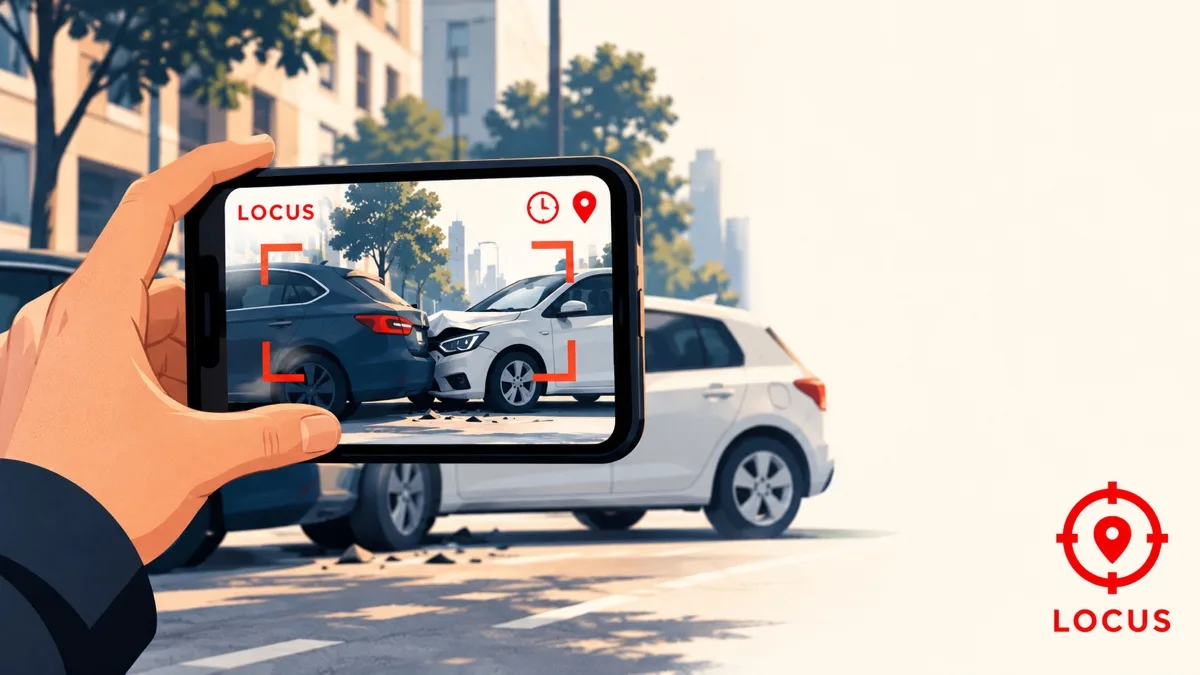
After a road accident the scene changes within minutes. Vehicles are moved, debris is cleared, traffic resumes. A photograph taken immediately preserves information that will soon be gone: the position of the vehicles, the visible damage, the road signs, the condition of the road surface.
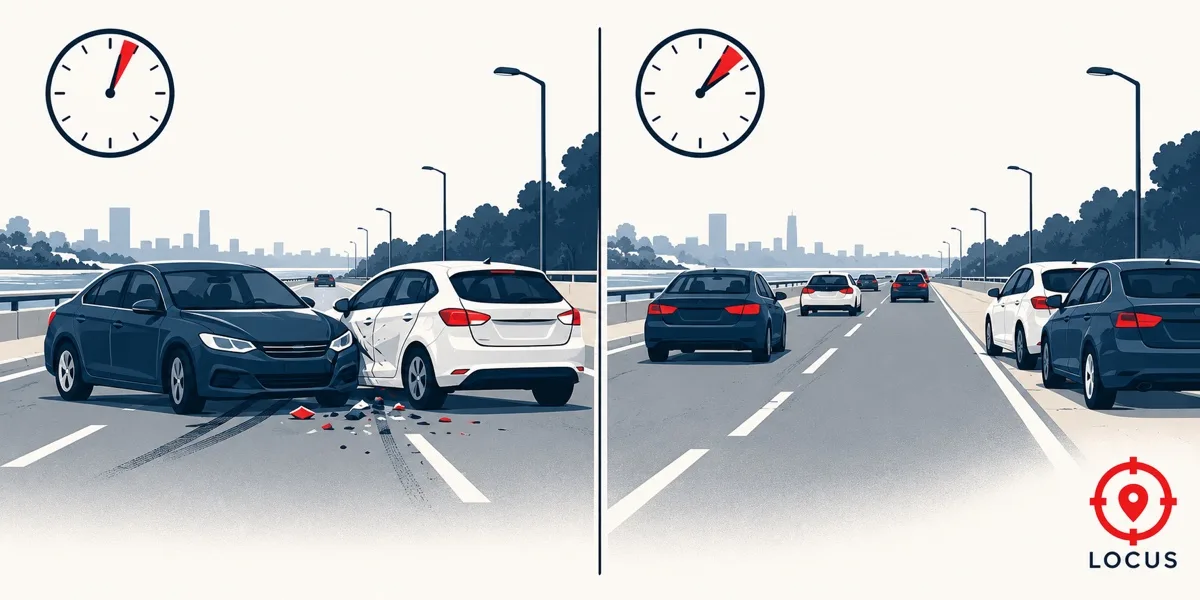
When those images end up in an insurance claim or in court, however, showing the scene is not enough. Four questions must be answerable: are these really the photos taken at the scene? have they been altered? where were they taken? and, above all, how long after the accident?
What the new Italian Highway Code provides
The draft of Italy’s new Highway Code gives weight precisely to images taken in the immediate aftermath of an accident. Article 74, paragraph 2, deals with accidents involving property damage only: alongside the duty to move the vehicles, it makes photos and videos taken by the parties at the scene and immediately after the event admissible in compensation proceedings, with an express derogation from Article 2712 of the Civil Code, which today allows the other party to simply repudiate a photographic reproduction.
Article 138, paragraph 2, addresses the investigation of offences connected with accidents: it covers photographs, videos and EDR data and requires enforcement bodies to use forensic acquisition and preservation procedures that allow integrity to be verified over time. Official text, Articles 74 and 138 (Italian).
As of 21 October 2026 these provisions are still part of a draft legislative decree: Government Act no. 448 was transmitted to the Chamber of Deputies on 14 October 2026 and assigned to the Transport and Budget committees, whose opinion is due by 12 January 2027. They are not yet rules in force, and the text may still change. Status of the procedure (Chamber of Deputies).
The direction, however, is clear: the photo taken at the scene enters the proceedings, and its weight depends on how much can be proved about when and under what conditions it was taken.
Shoot immediately, but safely
Article 189 of the current Highway Code already requires road users to protect traffic safety and, as far as compatible with it, to preserve the scene and the traces; with property damage only, obstruction must also be avoided where possible. Taking photos must not delay emergency services or expose anyone to traffic. Article 189 in force (Italian).
When it is safe to do so, both overall and detail shots are useful: the vehicles in relation to the carriageway, the points of contact, skid marks and debris, recognisable landmarks (signs, house numbers, poles). If a vehicle has already been moved, say so: LOCUS lets you record a voice or written note that goes into the package together with the photo.
Why a phone photo on its own is not enough
The date recorded by the phone does not prove when the picture was taken. The device clock can be changed, EXIF metadata can be rewritten with any editor, the location can be added or removed, and the file itself can be retouched before it is handed over. The recipient has no way to tell a photo taken at 17:42 at the scene from one taken the next day and backdated.What EXIF metadata actually proves.
This is where the repudiation allowed by Article 2712 comes in: the other party only needs to deny that the reproduction is faithful, and the photo loses most of its value. The problem is not the image; it is the absence of verifiable elements around the image.
What a photo acquired with LOCUS documents
LOCUS is an iPhone and Android app that acquires photos, video and audio and packages them, on the device, into an evidence package that anyone can verify, even without LOCUS. For every shot, the package documents four things, each with its own distinct evidence.
1. What was captured, and that it came from the camera
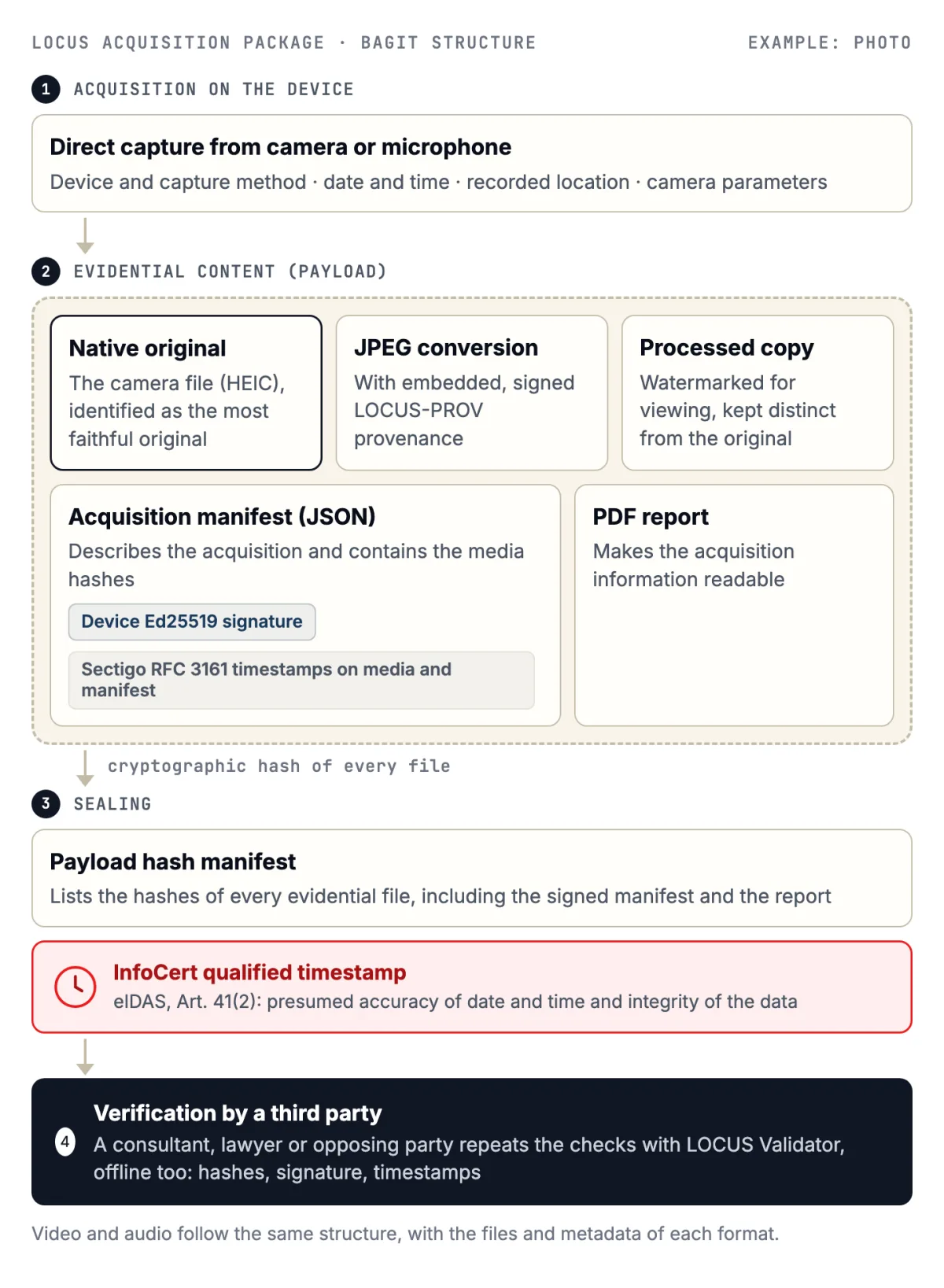
The photo is taken inside the app, with the device camera. The package contains the original file delivered by the camera (on iPhone the native HEIF), a JPEG working copy and a watermarked copy that visibly shows date and time, coordinates and the acquisition identifier. The camera’s EXIF metadata (make, model, lens, exposure, ISO) is preserved and, together with more than twenty device parameters, recorded in a separate file. The package also declares how the capture happened: from the live camera, not from a file picked in the gallery.
2. That it has not been altered
Three cryptographic digests (MD5, SHA-256, SHA-512) are computed for every file and written into a manifest signed with an Ed25519 key generated and kept on the device. Changing a single byte of a photo changes the digests and breaks verification. The package follows the BagIt standard (RFC 8493) used by digital archives: a list of every file with its digests, so that one can also check that nothing is missing and nothing has been added.
3. Where it was taken
The location is the one read from the device GPS at the moment of the shot, with declared accuracy, altitude and compass heading. It is written into the signed manifest, the watermark and the PDF report, with a map. The latest versions of the app also collect, around the capture, cross-checks independent of GPS (network fix, cell towers, Wi‑Fi, mock-location indicators), so that a spoofed position leaves inconsistent traces in the package.Geotagged photos as evidence.
4. When it was taken: two clocks and a qualified timestamp
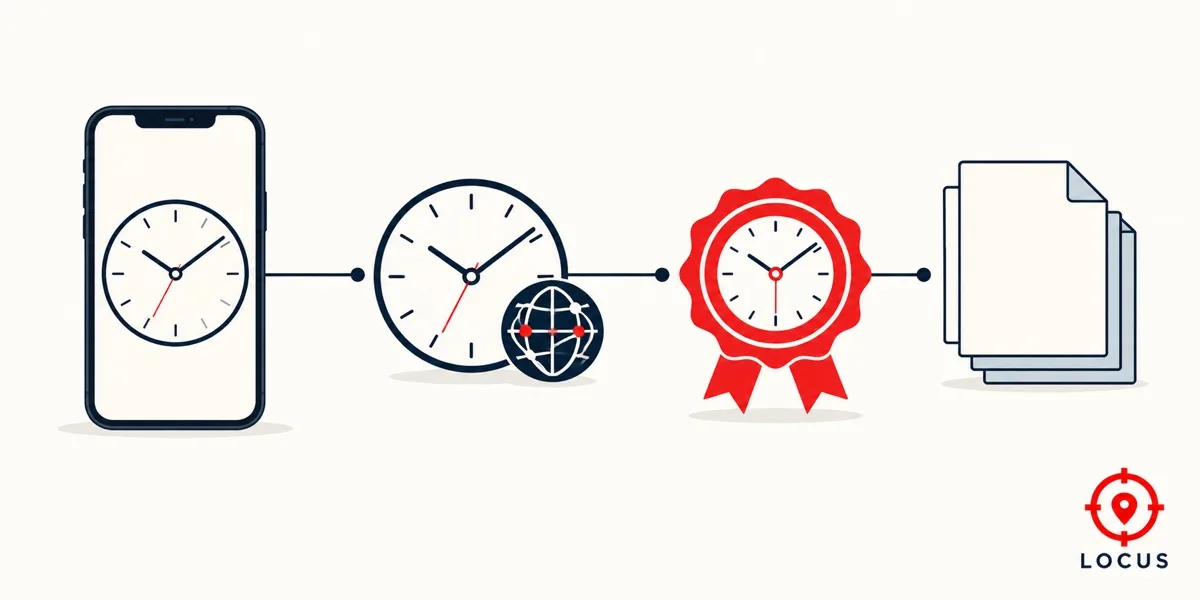
This is the point the new Code makes decisive. LOCUS records the device time, but compares it with network time obtained from NTP servers and writes the measured offset into the package: a manually shifted clock is documented, not hidden. Then, as soon as the package is sealed, it requests from a third-party authority an eIDAS qualified timestamp (InfoCert) on the signed list of all digests. The timestamp attests that those files, with those digests, existed at that instant: it is not data written by the phone, but by a third party that knows neither the user nor the content. The media file and the manifest also receive free RFC 3161 timestamps (Sectigo), so that every file has its own independent time reference.
For the purpose of immediacy the mechanism is simple: a timestamp obtained at 17:44 proves the photo already existed at 17:44. If the accident is shown to have happened at 17:40 by the police report, the emergency call or the vehicle’s event data recorder, the promptness of the shot is documented by a third party. Backdating is impossible: a timestamp can only be requested for a file that already exists, and requesting it the next day would attest the next day.How trusted dating works in LOCUS.
Verifiable by anyone, including the other party

The package is handed over as it is: a folder with the files, the signed manifest, the timestamps, a PDF report, an interactive HTML page that opens in the browser and recomputes the digests, and verification scripts for Windows, macOS and Linux. The recipient does not have to trust LOCUS: they can verify it with standard tools (sha256sum, openssl ts), with the free LOCUS Validator, which works offline and without an account, or from the public verification page that accompanies every acquisition.
This is why we say that a photo acquired with LOCUS is, as regards integrity, place and time, unassailable: not because we say so, but because every element can be recomputed by a third party and the time reference is set by an independent authority. Challenging that photo means having to explain how three cryptographic digests, a signature, the GPS position and a qualified timestamp issued by an unrelated party could all have been forged together, consistently.
What still has to be proved
It must also be said what the package does not do. File integrity, the truthfulness of the scene and the reconstruction of the dynamics are distinct questions:the same distinction between integrity and authenticity is drawn in the SWGDE guidelines. A digest proves the file has not changed since it was sealed; the timestamp proves since when it has existed; the GPS says where the phone was. None of these establishes who caused the accident, nor on its own the exact time of impact: that has to be reconstructed with the other available evidence. The package makes the photograph indisputable; the dynamics remain for the assessor to judge.
In practice, at the scene
- Safety first: people out of harm’s way, vehicles signalled, emergency services called if needed.
- Open LOCUS and shoot from the app, not from the system camera: only then does the photo enter the package.
- Overall views first, then details: vehicle positions, points of impact, traces, signage, landmarks.
- Note in a comment what has already changed (vehicle moved, debris cleared).
- Let the app complete the package with a network connection available: the timestamp is obtained at that moment, and that moment documents promptness.
- Keep the whole package and a backup copy; give the other party, the insurer or the court expert the package, not just the image.
Documenting the scene promptly means preserving information that could disappear. Making it verifiable means allowing others to examine its origin, location, time references and integrity.